
CONCERT œnm . œsterreichisches ensemble fuer neue musik
PROGRAM
David Conrat Fuentes
gegen.neben.mit
Jaein Hwang
Music for organisms, mechanisms and what's in between
Ida Grande Kaurin
I Want to Feel the Movement of Time
Tim Lugstein
Seething Fog
Luis P. Mann
Geometria et Lineae
Anna Skladannaya
Zwei Verse
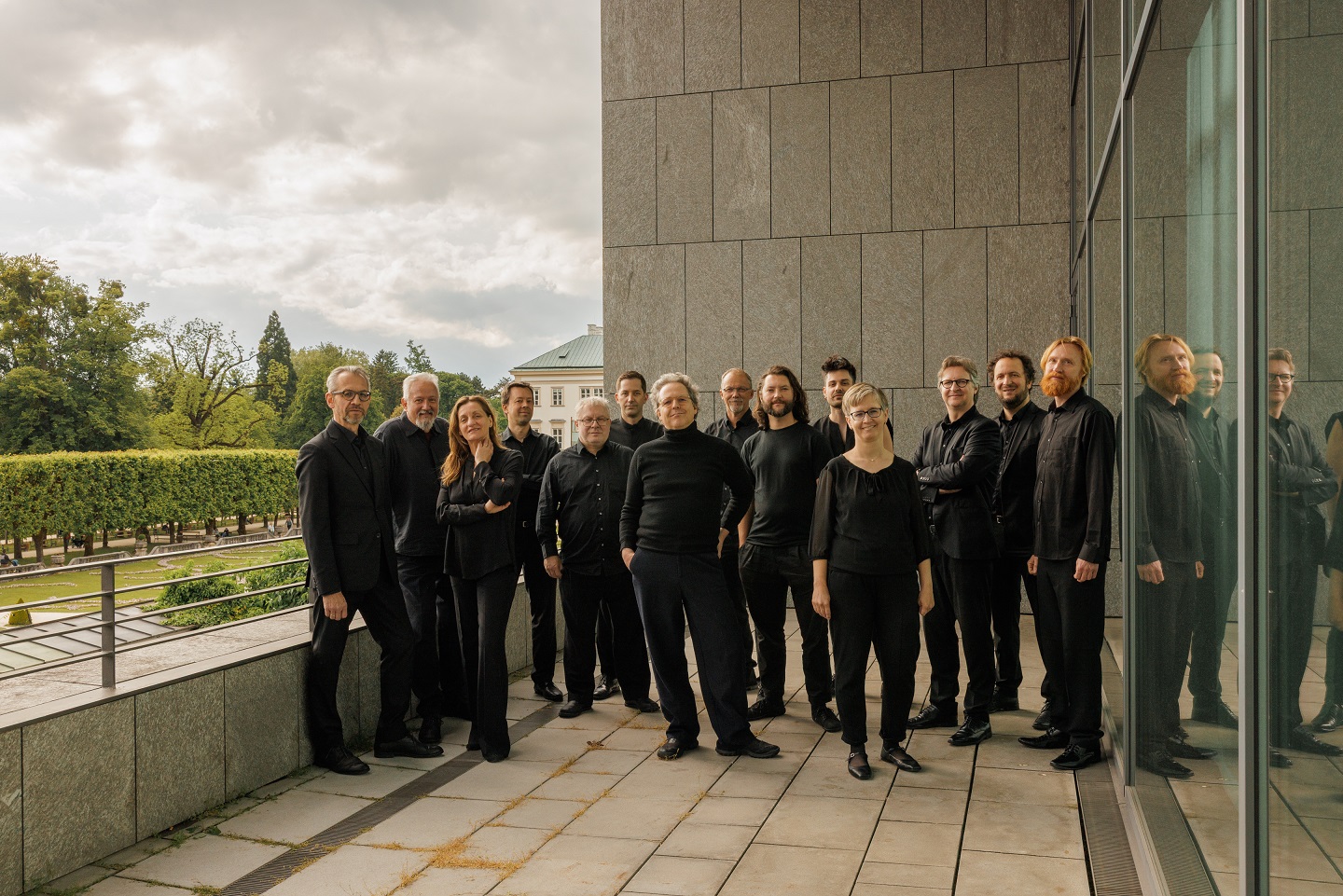
œnm . œsterreichisches ensemble fuer neue musik (AT)
David Conrat Fuentes
gegen.neben.mit
gegen.neben.mit (against.beside.with) for horn, trombone, tuba, percussion, piano, and accordion explores if and how two musical ideas can exist independently of one another – without being only in opposition or agreement. The piece endeavours to do so by going beyond the separation of two groups of instruments.
The title describes the overall structure. In the middle section, a gradual, organic musical process and its volatile, algorithmic counterpart develop separately alongside one another. The instruments constantly regroup, following one development and then the other. The lines touch and occasionally influence each other, yet assert their independence.
After the two processes culminate, they collapse into one another, giving rise to something new (“with”).
Jaein Hwang
Music for organisms, mechanisms and what's in between
Attack, Decay, Pitch Changes, Narratives —
The sound of a brass instrument does not end at the point of attack. Breath, lip tension, and air pressure continue to act throughout, and within that process lies an organic indeterminacy that cannot be fully quantified. Its glissandi work the same way: sliding freely between two notes or snapping onto the next harmonic leaving something immeasurable at the brink of pitch change.
In the piano and percussion, the conditions of a sound are mechanically fixed at the moment of impact. Glissandi shift in fixed intervals determined by the apparatus itself.
The accordion holds both characters. Its pitches are mechanically assigned by keys and buttons, yet the bellows are where the organicity of the body enters the instrument inseparably. On some lower notes, bodily pressure can bend the pitch itself.
Between two groups at opposite extremes, the intermediary survives, sometimes bridging the two, sometimes aligning with one alone. Narrative-wise, the music begins in the organic world — phrases unfold, accumulating tension and entropy — before giving way to mechanical time, where looping structures take hold.
Ida Grande Kaurin
I Want to Feel the Movement of Time
Certain existential questions bug me constantly, and time perception is one of them. In I Want to Feel the Movement of Time, I have tried to build a situation that insists on standing still, yet keeps interrupting itself from within, as if it cannot quite leave things alone long enough to stay there.
Tim Lugstein
Seething Fog
Imagine standing on a hill, looking over an autumn forest, seeing a city in the distance and feeling a sense of calm but also an extreme inner hurry simultaneously. The cold stillness of fog, the seething molecules of lava. The serenity of a working system, the pressure of keeping a system working.
Luis P. Mann
Geometria et Lineae
This piece is conceived as a concertino. The title Geometria et Lineae is inspired by Lorenz Stöer’s series of drawings Geometria et Perspectiva. In these works, Stöer depicts geometrical objects from different perspectives and angles, often bringing several objects together in a single drawing resulting in interesting and thoughtful compositions. When looking at these drawings, I discovered an interesting connection between them and my own composition. What intrigued me most is the relationship between mathematics and art: In Stöer’s case, it is visual art, in my case, it is music.
In Stöer’s drawings, this relationship takes shape by demonstrating mathematics through geometry, with its different objects and their properties shown from various perspectives and angles. In a whole drawing, the composition of objects, their different perspectives, colours and environments create interesting relations and communication between them. In my piece, I also see geometrical objects or rather sculptures, which are intersected and connected by lines - therefore the title Geometria et Lineae - and thus create a composition of relations and communication between them, unfolding into a larger sculptural dramaturgy. Like in Stöer’s drawings, I see my objects also in different colours and environments. However, besides the title and the descriptions, the piece is non-programmatic. Geometria et Lineae is absolute music in the sense of a concertino.
Anna Skladannaya
Zwei Verse
Verse 1: Chords like heartbeats deep beneath the surface of the lake. A melody flowing endlessly, like a slow, graceful dance.
Verse 2: The feeling of sparkling water on the skin, like a bird flying through the storm, forever reaching toward the sun.
FREE ENTRY!
This event will be recorded in image, sound, and video. Information on data protection can be found at:
www.moz.ac.at/de/datenschutzerklaerung